
250 Years of American Independence- How France Helped Turn the Tide of the War
As she does every summer, Dr. Dominique Fradin-Read enjoys stepping away from the medical field to explore a topic that is simply fascinating and of broader historical interest.

As the United States celebrates the 250th anniversary of its founding, it is an ideal opportunity to reflect on the remarkable role that the French-American connection played in the birth of the nation. While the Declaration of Independence was signed on July 4, 1776, the young United States was far from secure. It was France's diplomatic recognition, financial support, military alliance, and naval power that helped transform a fragile rebellion into a successful fight for independence. Without French intervention, many historians believe that the outcome of the American Revolution might have been very different.
This extraordinary partnership not only secured American independence but also left a lasting legacy on both sides of the Atlantic. Ironically, by helping establish a new republic founded on the ideals of liberty and self-government, France also helped sow the seeds of the French Revolution just a few years later.
As we commemorate America's 250th anniversary, it is worth remembering that the story of the United States is also, in many ways, a story of one of history's most consequential international friendships.
Would the United States have achieved independence without French assistance?
This is the question asked by a journalist in a recent French article.
After months of discreet support, France officially allied itself with the American insurgents in their war against the British Empire. This decision would permanently alter the destiny of both nations.
On July 4, 1776, the thirteen British colonies in North America broke with the Crown and declared their independence. Two hundred and fifty years later, this founding act continues to captivate historians and the public alike. To mark this anniversary, an article in the journal France 24 looks back at the decisive—and often overlooked—role France played in the birth of the United States.
The article argues that France was indispensable to the success of the American Revolution, and that the United States might not have won its independence without French support. Although the thirteen American colonies declared independence from Great Britain on July 4, 1776, they continued fighting a difficult war against the British Empire. France initially provided secret assistance by supplying weapons, ammunition, and financial aid while avoiding open conflict with Britain.
The turning point came after the Battle of Saratoga in October 1777, where the Americans defeated a British army. This victory convinced King Louis XVI that the American cause had a real chance of succeeding. In December 1777, France became the first country to officially recognize the independence of the United States. A few weeks later, in February 1778, France and the United States signed treaties establishing both a military alliance and a commercial partnership. From that moment, the Revolutionary War became an international conflict between Britain and France, rather than simply a colonial rebellion.
In Paris, Benjamin Franklin played a vital diplomatic role by winning the admiration of the French court and public, helping to secure continued French support. Meanwhile, the young French nobleman Marquis de Lafayette became one of the Revolution's most famous figures. After volunteering to fight alongside the Americans, he developed a close relationship with George Washington and later returned to France to persuade Louis XVI to send a full expeditionary force under General Rochambeau.
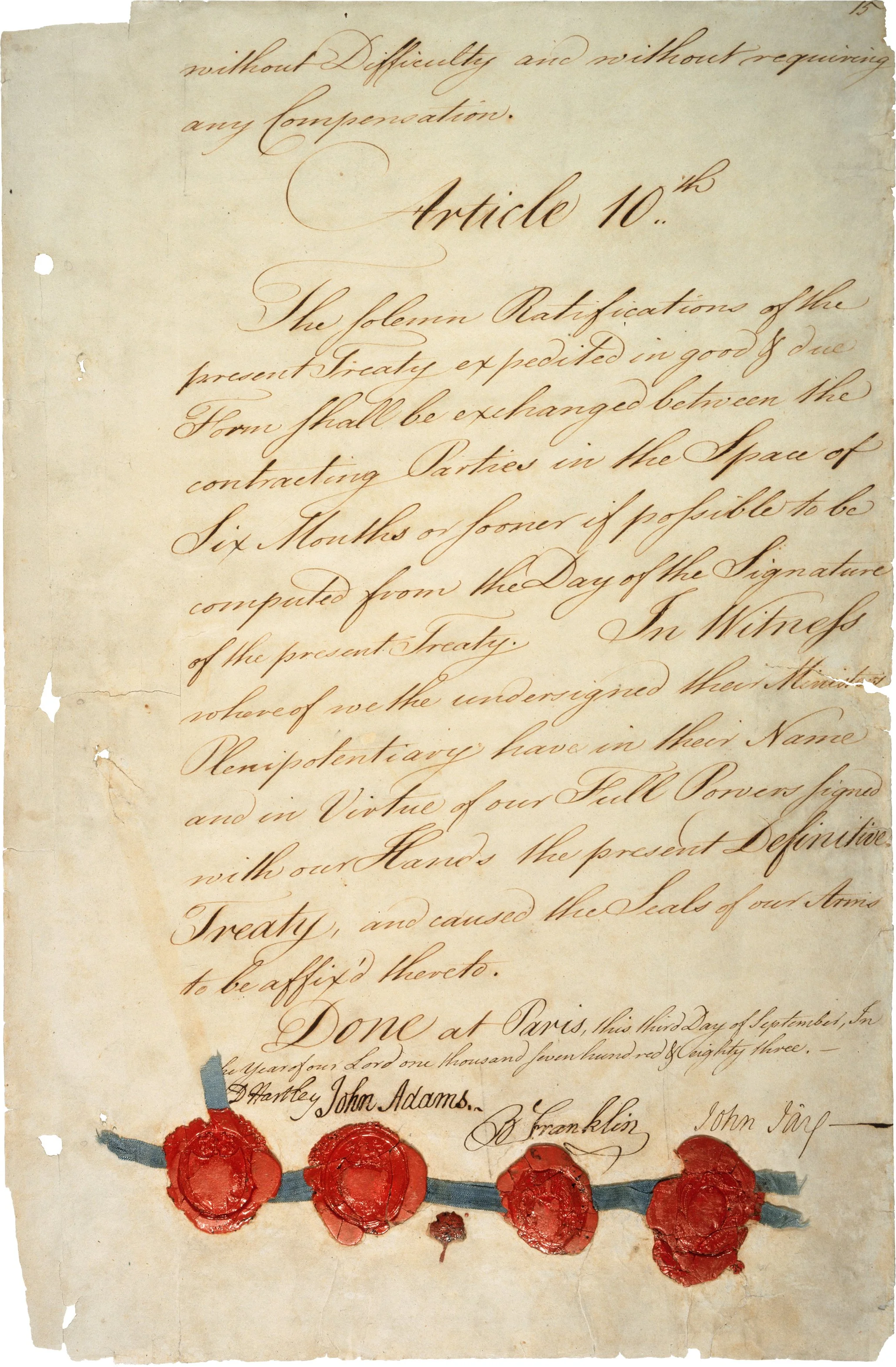
Treaty of Paris (1783) This treaty, signed on September 3, 1783, between the American colonies and Great Britain, ended the American Revolution and formally recognized the United States as an independent nation.
Treaty of Paris; 9/3/1783; Perfected Treaties, 1778 - 1945; General Records of the United States Government, Record Group 11; National Archives Building, Washington, DC.
French military involvement reached its peak in 1781 during the Battle of Yorktown. While Washington and Rochambeau led the combined American and French armies on land, Admiral de Grasse's fleet defeated the British navy in Chesapeake Bay, preventing British forces from receiving reinforcements or escaping. Surrounded by land and sea, British General Charles Cornwallis surrendered on October 19, 1781. Historians generally regard Yorktown as the decisive battle that effectively ended the war and ensured American independence.
The conflict officially concluded with the Treaty of Paris in 1783, signed in the French capital, in which Great Britain formally recognized the independence of the United States. France achieved its main strategic objective of weakening its longtime British rival, but its territorial gains were relatively modest.
The victory, however, came at an enormous cost. France spent more than a billion pounds financing the war, adding to an already severe financial crisis. At the same time, the American Revolution's ideals of liberty, equality, and popular sovereignty spread throughout France. Influential figures such as Thomas Jefferson and Lafayette helped circulate these ideas, which inspired many French reformers.
Ironically, by helping to create a republic in North America, Louis XVI unintentionally contributed to the conditions that led to the French Revolution in 1789 and ultimately to the downfall of his own monarchy. The article concludes that France's support was not only decisive in securing American independence but also had profound and unexpected consequences for France itself.
We can also remember that this enduring Franco-American alliance did not end with the American Revolution
More than a century and a half later, history came full circle when the United States played a decisive role in helping liberate France during the Second World War.
On June 6, 1944, American, British, Canadian, and Allied forces landed on the beaches of Normandy in one of the largest amphibious operations in history. The D-Day landings marked the beginning of the liberation of France from Nazi occupation and ultimately led to the defeat of Hitler's regime in Western Europe. The sacrifice of thousands of American soldiers on French soil forged an even deeper bond between the two nations.
History reminds us that true alliances are built on mutual support across generations. France stood beside the young United States during its fight for independence, providing the diplomatic recognition, financial backing, military forces, and naval power that made victory possible. Nearly 170 years later, America and its Allies stood beside France in her darkest hour, helping to restore her freedom and sovereignty.
As we celebrate the 250th anniversary of the United States, it is fitting to honor not only the birth of a nation, but also one of the world's oldest and most enduring friendships—a partnership founded on shared ideals of liberty, democracy, and the belief that free nations are strongest when they stand together.